
Linear static analysis
- stresses, strains and displacements under static loads, assuming linear material behavior and small deformations
- commonly used for initial strength and stiffness assessments
Verifying that a structure carries its loads without excessive deformation or failure.
Talk to a structural engineer arrow_forwardThe aim of a stiffness and strength analysis is to evaluate whether a structure or component can withstand the applied loads without excessive deformation (stiffness) or failure (strength). It helps engineers verify that the design meets performance, safety, and durability requirements.
The outcome of a stiffness and strength analysis is a detailed assessment of stresses, strains, displacements, safety factors, and critical load conditions. These results identify potential weak points and support design optimization to ensure structural integrity and reliable operation.
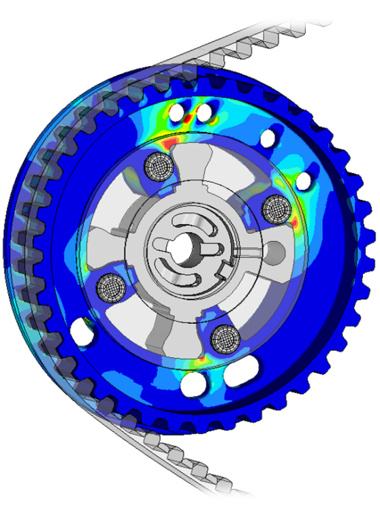
The deformation behaviour of a camshaft phaser system including the rotor and stator is crucial in terms of efficiency. The manufacturing tolerances must be very accurate: the gap between rotor and stator surfaces should be big enough to avoid tension, but small enough to minimize oil leakage. We analysed the deformations of the parts under different operational loading conditions and developed a method to evaluate the smallest enclosing circle of the deformed rotor and the largest inscribed circle of the deformed stator. It helped the design engineers to define the manufacturing tolerances.
Schedule a discovery call and together we decide what is needed to achieve your design objectives.
Receive a proposal within 3 days. For a one-time project, a 2–4 week service package meets most clients' needs.
When all input data specified in the proposal is given, a kick-off call gets the project started.
We issue a project status report document outlining background, modeling details, boundary conditions to ensure common understanding of the details.
We work collaboratively and quickly to meet objectives, maintaining focus on how design variants will be impacted based on simulation results.
The project report is updated with simulation results and design suggestions, and meetings are used to discuss conclusions and define next steps.
Achieve greatness.
Drop your project specs below. We'll analyze your requirements and get in touch within 2 business days to discuss the technical approach.