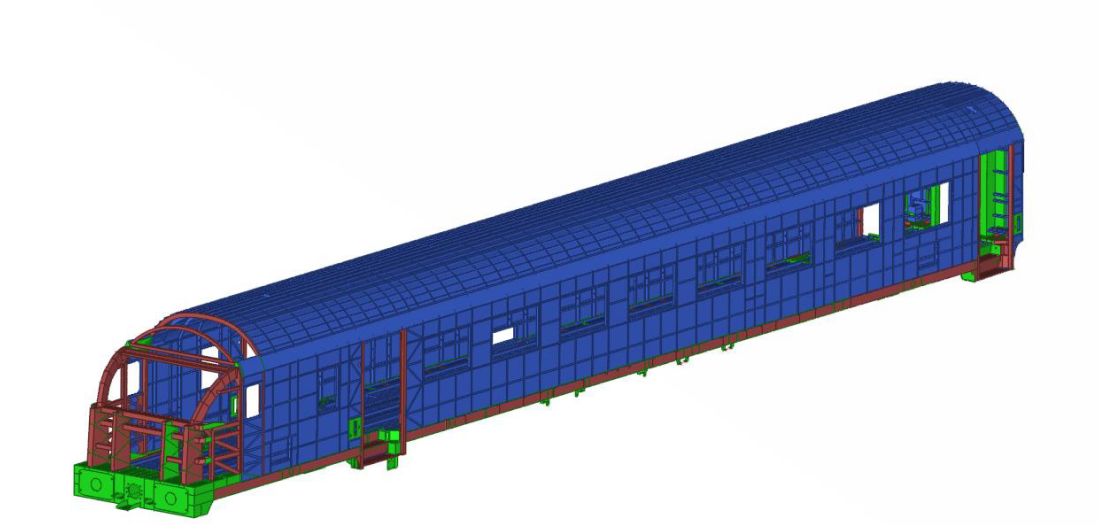
Supplying first- and second-class IC+ passenger coaches to the domestic rail network and also serving other customers in the region. In 2021 the IC+ family was planned to be extended with a new vehicle type: a driving trailer — mechanically a passenger coach with a driver's cab at the non-locomotive end, allowing the train to reverse at a terminus without shunting. As a large welded steel car body carrying passengers and a driver, the vehicle required a full analytical clearance package covering both static structural integrity and crashworthiness before type approval could be issued.
With the driving trailer's design geometry reaching the necessary maturity and type approval on the roadmap, MÁV Vagon required a complete finite-element verification programme covering EN 12663 (18 static load cases) and EN 15227 (three crash scenarios), plus the material characterisation feeding both. They engaged eCon to build the full FE model, run both verification streams end-to-end, and perform the underlying tensile tests in-house.
MÁV Vagon runs an in-house FE team — sufficient for routine internal analysis and day-to-day workload, but peaks caused by a two-year intensive development programme on a large welded car body can be rationally handled by involving a development service provider. Static verification of a 53 t rail vehicle is not exotic work in isolation; at 18 static load cases plus three crash scenarios plus supporting material characterisation, the sustained volume required dedicated external hands.
eCon fit because its simulation team carries both rail and automotive crash references, and its in-house materials laboratory could supply the tensile characterisation the crash simulations needed as input — a single-supplier chain from coupon to compliance.
eCon built a mid-surface shell model in ANSA. Exploiting X–Z symmetry, a half-model was constructed — approximately 1 714 582 elements at 10 mm nominal edge size (40 mm on roof and floor). Welds, concentrated masses representing larger units, and a rigid-link plus spring-element bogie representation completed the model; the reconciled full-vehicle mass came to 53 582 kg.
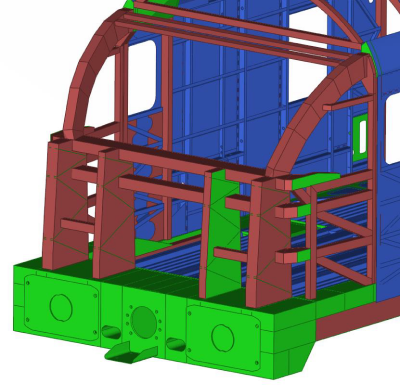
The finite-element model
eCon's materials laboratory ran tensile tests on 30 S355 plate coupons at three nominal thicknesses (2 / 4 / 6 mm), per EN ISO 6892 geometry, on an Instron 8801 servo-hydraulic machine instrumented with an Epsilon 3650-BIA biaxial extensometer. A piecewise-linear elasto-plastic curve was fitted for each thickness group. These curves became the direct MAT24 input to the LS-DYNA crash runs — the EN 15227 simulations ran on a material card measured from the plate the vehicle is built from, not on catalogue data.
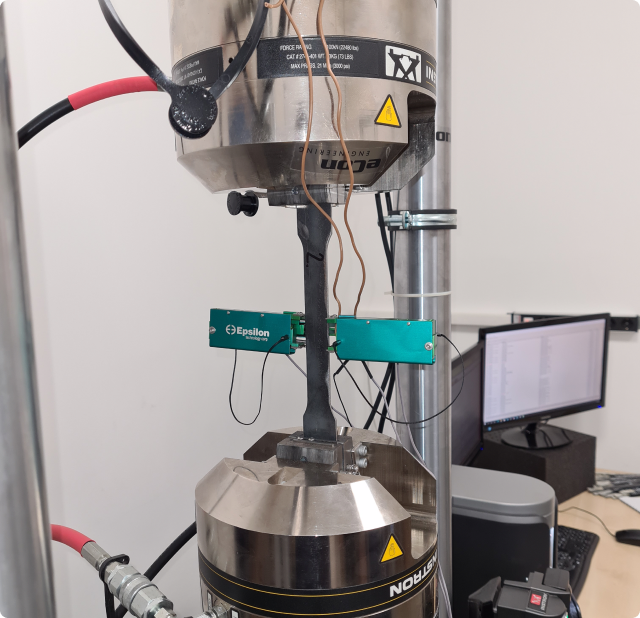
Tensile test in eCon's laboratory
Across the 18 prescribed static load cases — proof, exceptional, and fatigue — the model was simulated in ANSYS and evaluated against the material yield ceiling. Volume, not method development, was the load in this stream.
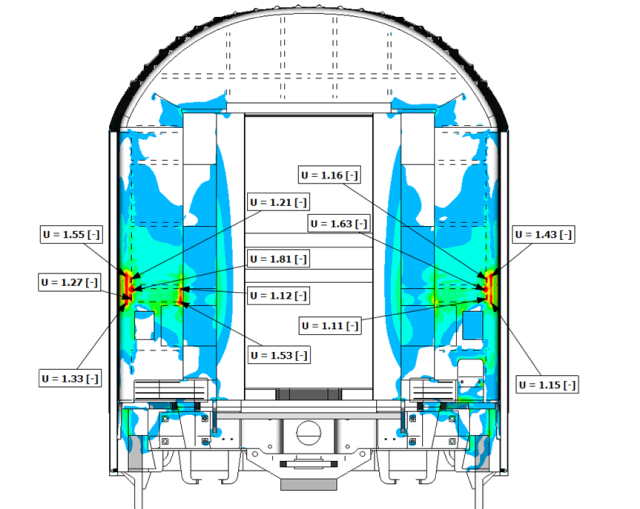
Static verification
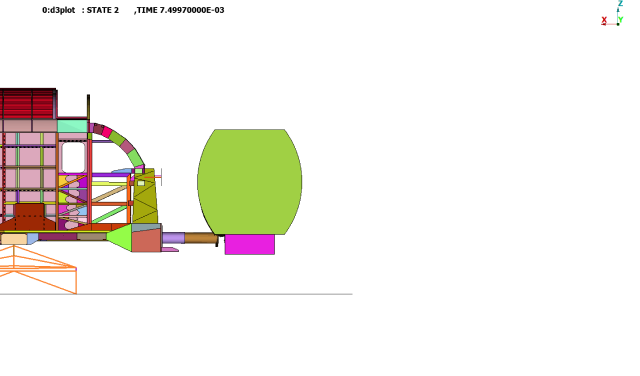
The buffer models (EST DUPLEX R2.A2 leading, EST R1-200 trailing) were validated against manufacturer force–displacement characteristics before the full-vehicle runs. Scenarios 1 and 2 — 36 km/h head-on into an identical stationary train, and impact into a stationary 80 t freight wagon per EN 15227 Annex C.1 — passed the 10 g / 30 ms and 5 g / 120 ms deceleration ceilings, survival space, and wheel lift on the first evaluation.
Scenario 3 was where the programme stopped being routine. The scenario, defined by EN 15227 Annex C.4, is a 110 km/h impact into a 15 t deformable tank obstacle. The impact is lateral against a soft, tall and heavy target, so a crush element and its seamless integration to the frame structure governs the outcome. The first front-frame design failed: the crush element did not provide enough absorbed energy and the frame behind it yielded. The eCon team worked together with the constructor on a smaller structural modification. The revised design failed on the second run, suggesting the need for more drastic measures. A second modification cycle — again with eCon working closely with the design team on the reinforcement path — produced the third iteration, which met the crashworthiness criteria and was accepted as the design of record.
Crash verification
Validated buffer energy absorption was 1 228 kJ (front, at 743 mm travel) and 224 kJ (rear, at 300 mm travel). Scenario 3, after three design iterations, produced a maximum front-frame deformation of 185 mm longitudinal and 93 mm vertical, with survival space in the passenger area preserved. The third-iteration front-frame reinforcement became MÁV Vagon's design of record for the driving trailer.
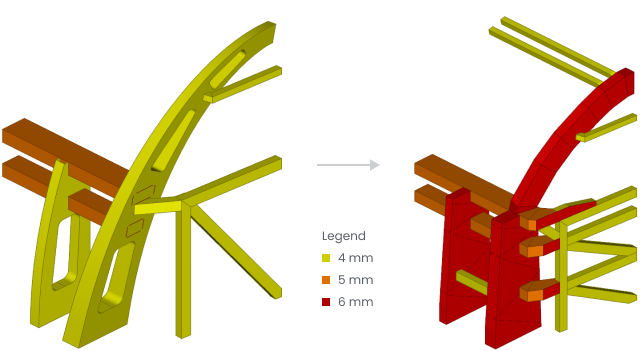
Both EN 12663 and EN 15227 verifications passed. In the crash scenario where the first design didn't hold, simulation experts from eCon worked together with our design team on the reinforcements that made it pass the crash requirements.
— Firstname Lastname, Head of Engineering, MÁV Vagon
Drop your project specs below. We'll analyze your requirements and get in touch within 2 business days to discuss the technical approach.